How a comparison is judged
A random vibration test is judged against a band: the specification
says what the control PSD must be, and warning and abort lines say
how far it may stray. Whether a measurement met that is one question
asked cell by cell, and the answer is the same whatever form the
two objects take — a controller's target on its lines, a requirement
written at a few breakpoints, or either banded onto octave bands,
against a narrowband PSD or a banded one. This page states the rule
and shows every comparison there is, each figure drawn by the same
call the application uses (tools/make_concept_figures.py regenerates them).
The rule
A PSD is a density, and a density means its area — how a PSD means its area says why the picture and the integral come from one reading. A comparison is built on that:
- The cells. The comparison happens on the coarser of the two grids. A requirement written per octave band is a requirement on the band's power, not on every line under it. When both are on lines, the wider lines are the cells; when the requirement is a curve between breakpoints, the measurement's own bins are. A measurement on octave bands is compared band against band with a requirement on the same bands, and with nothing else.
- The stretch. Each cell is cut to what both objects speak for: the lines or bands the requirement is written on, and the lines the measurement holds. A controller stores its target on every FFT line to Nyquist and writes zero or NaN where it did not control — those lines are holes, not a requirement of nothing. A cell nothing is written in is not judged; one written over part of its width is judged over that part, and only that part.
- The judgment. Over each cell's stretch, the measurement's power — its area, read as it is drawn — against the power the limit asks for over the very same stretch, the limit read the way its specification is: the exact area under the power law between breakpoints, a density per line or per band otherwise. The cell is out when it holds more than the upper abort limit asks, or less than the lower one.
- The level. The RMS error compares the two areas summed over every cell: the measurement's against the requirement's, both over the same stretches. The band outside abort counts the cells that are out as a share of the cells judged, each weighted by how much of itself was judged — a line cut in half by the end of a written stretch counts for half. Six bands out of forty-seven read as thirteen percent whether they sit at the bottom of the range or the top, which a share of the width in hertz did not: proportional bands are equal in log frequency, so the highest band of a sixth-octave decade set is two hundred times the width of the lowest.
One function holds it — visualdynamics.core.compliance.judge — and
the compliance table, the application's comparison plot and the
report's page all ask it. A line boxed red on the plot is a cell
counted in the table.
The three comparisons
A measurement is on lines or on octave bands; a requirement is a
curve at breakpoints, a controller's density per line, or on octave
bands. Three of the pairings are comparisons. A narrowband PSD is
judged against a breakpoint curve or against a requirement on lines;
a banded PSD is judged against a requirement on the same bands, and
only that. A requirement on octave bands says nothing about the
lines under its bands, and a band's power cannot be attributed to
part of its width, so a narrowband PSD against a banded requirement,
a banded PSD against a curve or lines, and sixth-octave bands
against third-octave bands are not judged: nothing is marked, the
comparison answers with the reason, and the window's status line
shows it. Band the other object the same way — compute_octave on
the specification bands its limits with it — and compare band
against band. A report block that bands a measurement for itself
bands the specification with it.
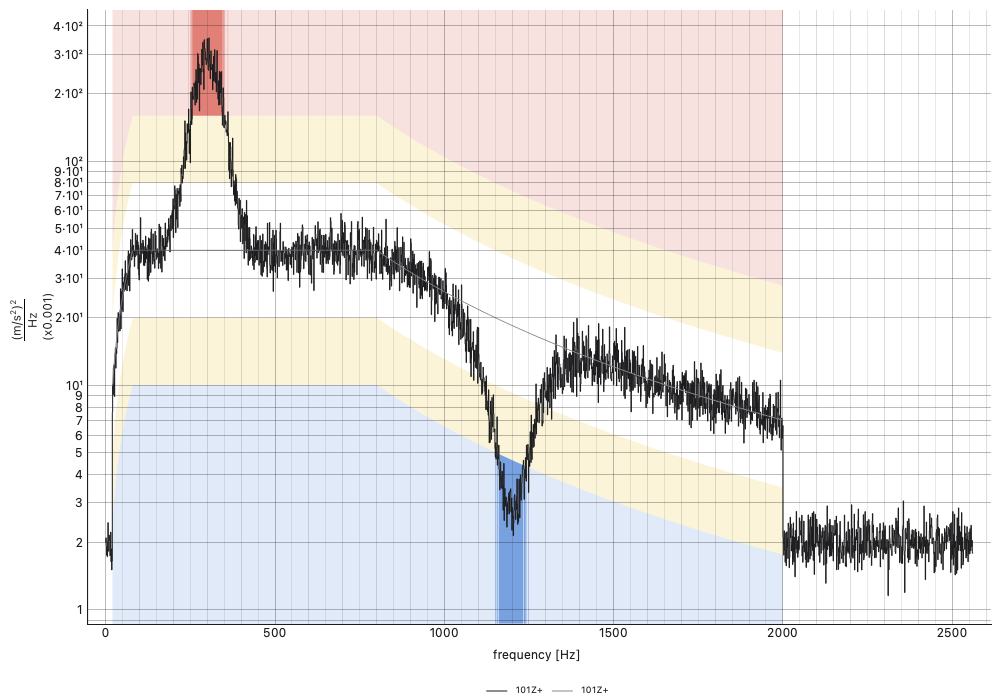
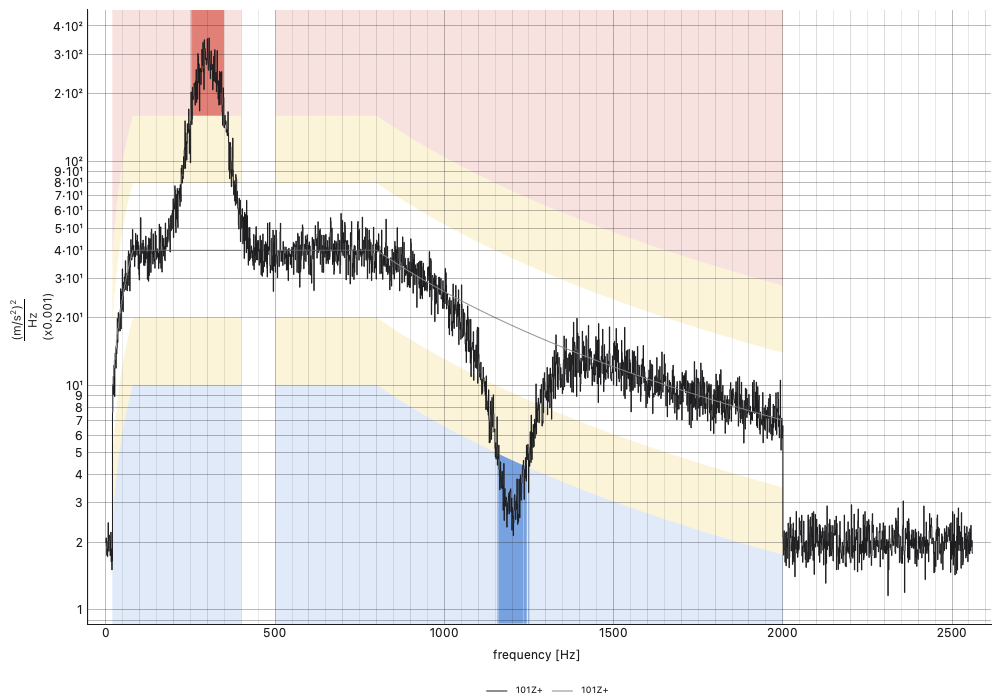
Every figure below is one measurement of the same requirement: a decade of flat top with power-law skirts, warning at ±3 dB and abort at ±6 dB, written at four breakpoints. The measurement sits on the target with two departures — a resonance over the upper abort limit near 300 Hz and a notch under the lower one near 1200 Hz — and runs on to Nyquist, past the requirement's end at 2000 Hz.
A narrowband PSD against a breakpoint specification
The requirement is a curve, so the cells are the measurement's own 1 Hz bins. Under each bin the exact power-law area of the limit is what the bin's power is judged against; on a slope that is a little more than the limit's value at the bin's center, and on a breakpoint the bin is judged on both sides of the corner at once. The bins at the two ends are cut at the first and last breakpoint and judged over the part inside — a line's density is flat across a hertz, so the cut is exact.
A narrowband PSD against a specification on lines
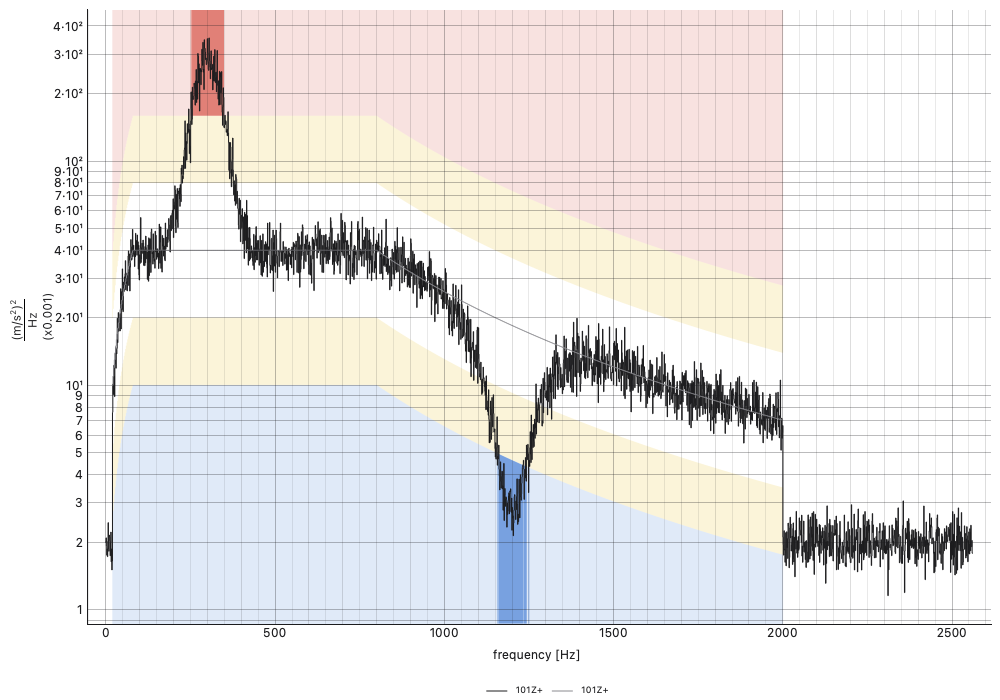
A controller writes its target as a density per line. Here the lines are 2 Hz apart and the PSD's are 1 Hz apart, so the cells are the requirement's lines and each takes the two measured bins under it, integrated. Lines the controller wrote as NaN — everything past 2000 Hz — are not judged.
An octave-band PSD against an octave-band specification
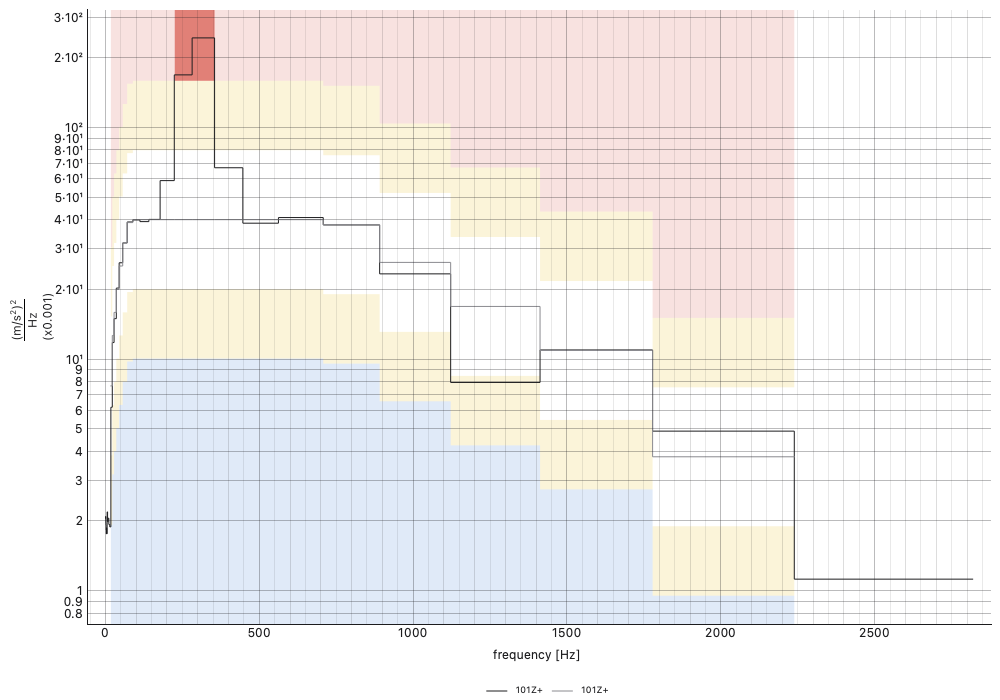
Both on the same bands, same fraction: band against band, each band's power against its band's limit. The resonance's band is boxed red as a whole; the notch, which the line-by-line figure boxed blue, averages back inside its band's lower limit — a requirement on bands asks about band power, and that is what is judged. Banding conserves area, so the RMS error is the narrowband pair's to within the end bands.
The edges
Where a requirement ends inside a band
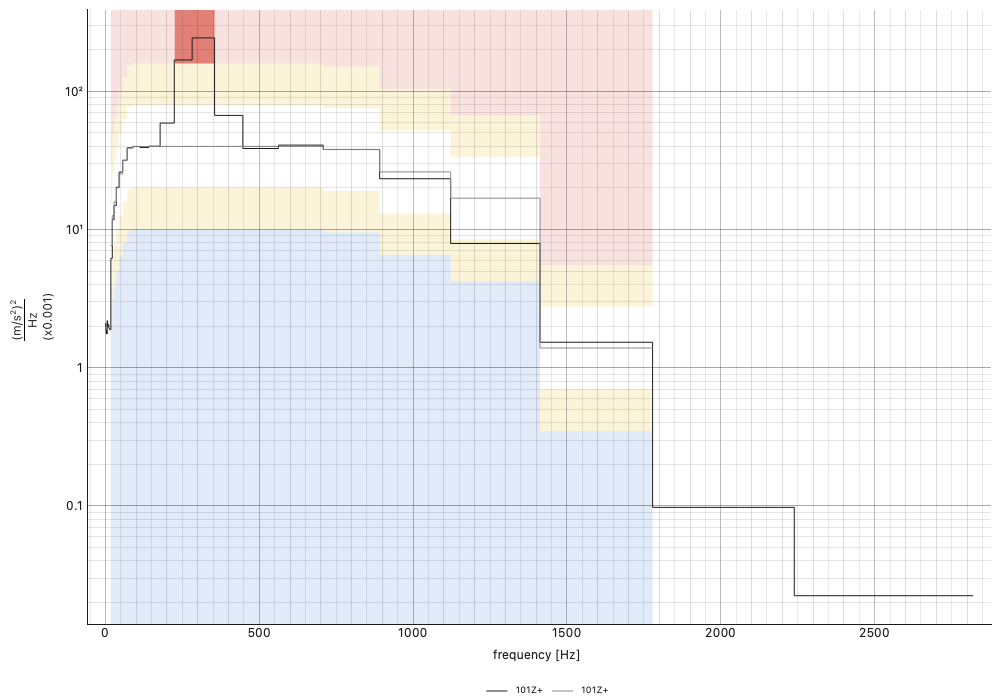
Here the requirement's lines end at 1450 Hz, and the third-octave band that holds 1450 Hz reaches to 1778. An octave band is a defined frequency band: banding keeps it whole — its center, width and edges are the standard's — and the band holds what the lines put in it, spread over its whole width, so the banded requirement's last band reads lower than its neighbors. That is what a band of a requirement ending inside it is, and the octave-band specification says so rather than pretending the requirement reached 1778 Hz.
The banded measurement is judged against it over the whole band, 1413 to 1778 Hz, and in the case that happens that is fair. A controller holds the narrowband response to the requirement and drives nothing past it, so the response falls away past 1450 Hz too; its band then holds about what the requirement's band holds, and the band is in. The figure is that case: the response is on the target to 1450 Hz and a fiftieth of it beyond, the last band of each side sits low together, and past the last band nothing is judged.
What the band would say about a response that did not fall away — one running on at the target's level to 1778 Hz — is that it holds several times what the banded requirement asks there, and the band would be out. That is a true statement about the band: the requirement, banded, asks for that much power in that band and no more. It is not a statement the narrowband comparison would make, since its cells stop where the lines do, and it is the reason to read the narrowband figures for the end of a requirement.
A hole in a requirement
A controller's notch — lines written as zero across 400–500 Hz. Zero is not a requirement of silence: those lines say nothing, and cells falling in the notch are not judged. The RMS is taken over the written lines only, on both sides.
Checking it
from visualdynamics.core.compliance import cells, compare, judge

found = cells(specification, measured)        # the cells, cut to what both hold
verdict = judge(specification, measured, limit='abort_upper', over=True)
verdict['out']                                # a bool per cell
verdict['lines']                              # the same, on the measurement's lines
result = compare(specification, measured)     # RMS error, band outside abort
The array form, compliance.outside, judges a limit and a
measurement held as plain arrays through the same rule, and
compliance.comparable says in words why a pair is not compared,
or None when it is.