The transient workflow
A transient test names the motion itself, sample by sample — where a shock test names a response spectrum and leaves the waveform to the controller. So a transient run is judged as two waveforms of the same thing: the target the controller was asked to reproduce, and what the article actually did, compared at one control channel at a time.
The walkthrough is the demonstration plate's own replication run —
the plate's response to a burst at its corner drive, replicated by
two shakers under a real Rattlesnake controller — photographed at
every step. The run lands at stressdata/plate/transient.nc4 and
regenerates with generate_plate_runs.py --transient in the
generators repository.
| Step | In the app | In a script |
|---|---|---|
| Import the run | drag the controller's .nc4 onto the window |
project.import_file(path) |
| Say what it is for | (the run says — the type switches itself) | project.project_type == 'Transient' |
| The target | (it arrives with the run) | project.transient_specification |
| Read the target | select it — one channel, drop-down for the rest | spec.plot(...) |
| Overlay | select the pair — the replication views appear | plot_replication(history, spec, 'overlay') |
| Waveform error | the plot bar's error view | plot_replication(history, spec, 'waveform') |
| PSDs of both | Compute PSDs in each averaging view | project.compute_psds(name) |
| Geometry and photos | drag them in, link them | project.add(...), project.link(...) |
| Report | Generate Report on the bar, the project row selected | project.generate_report('transient') |
| Export | Export HTML… | project.export_report(name, path) |
| Save | Save Project As… | project.save('transient.vdyn') |
In the app, step by step
1. Import the run
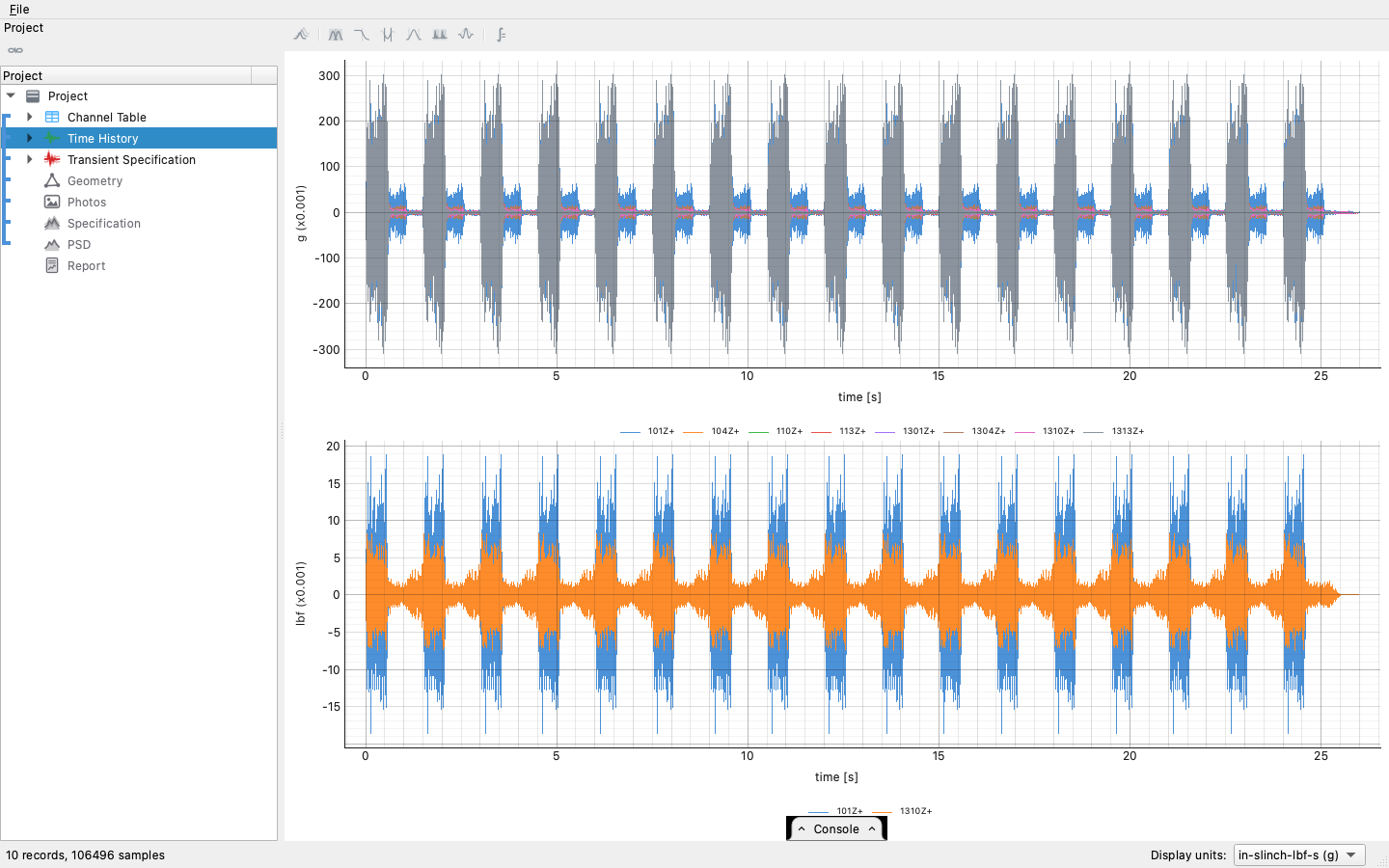
A transient replication run carries the measured control channels, the drive forces, the channel table — and the target waveform itself, which imports as the Transient Specification. The type switches to Transient and the tree grows the slots a transient report needs.
The record is read as playings: the controller played the target over and over, and the run's frames are those repeats — nothing is detected or guessed. The time view shades them on the trace.
2. Read the target
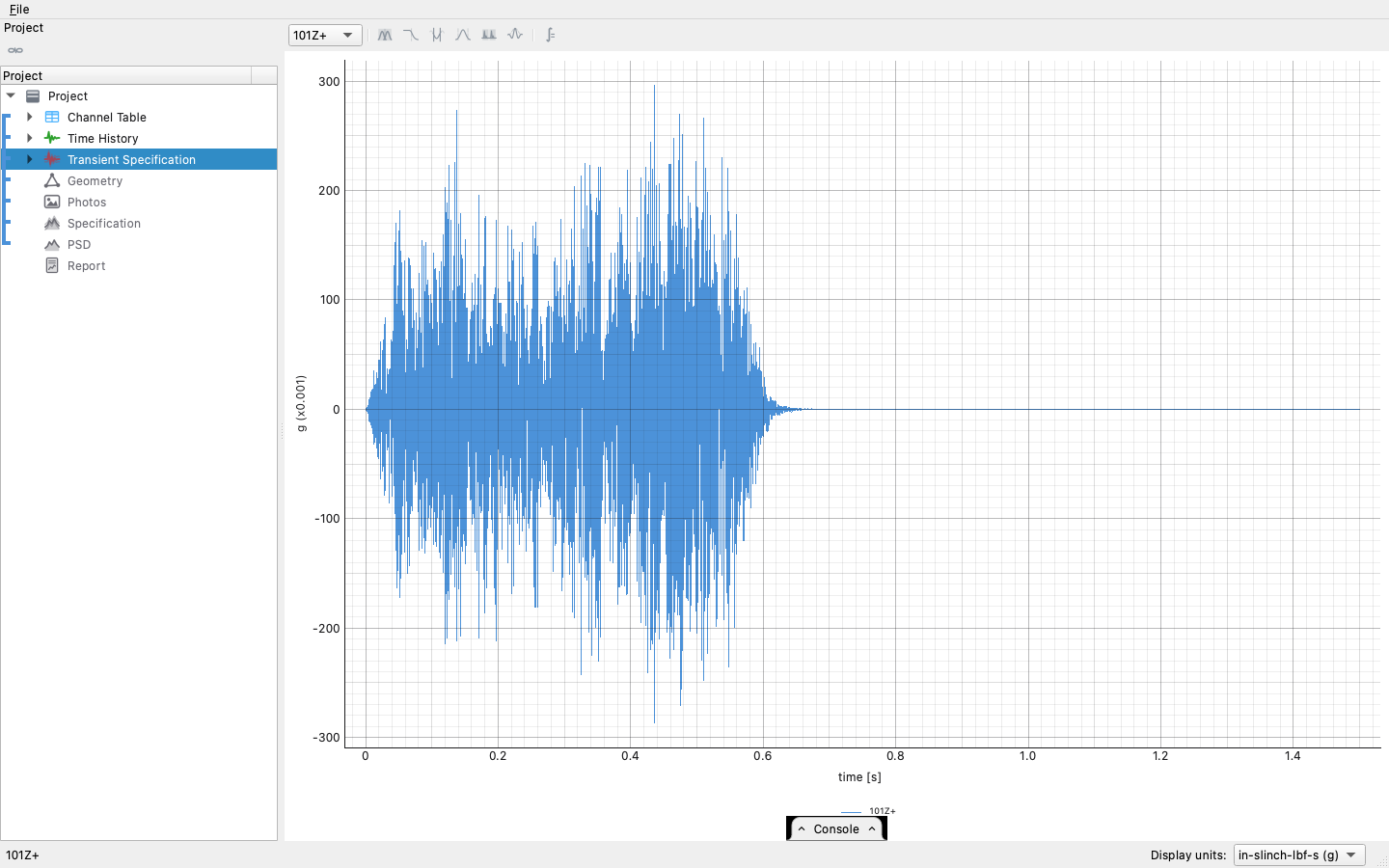
Select the specification on its own. One channel draws at a time — its waveforms stacked are a thicket with no comparison in them — and the drop-down on the bar reaches the rest.
3. Compare waveforms
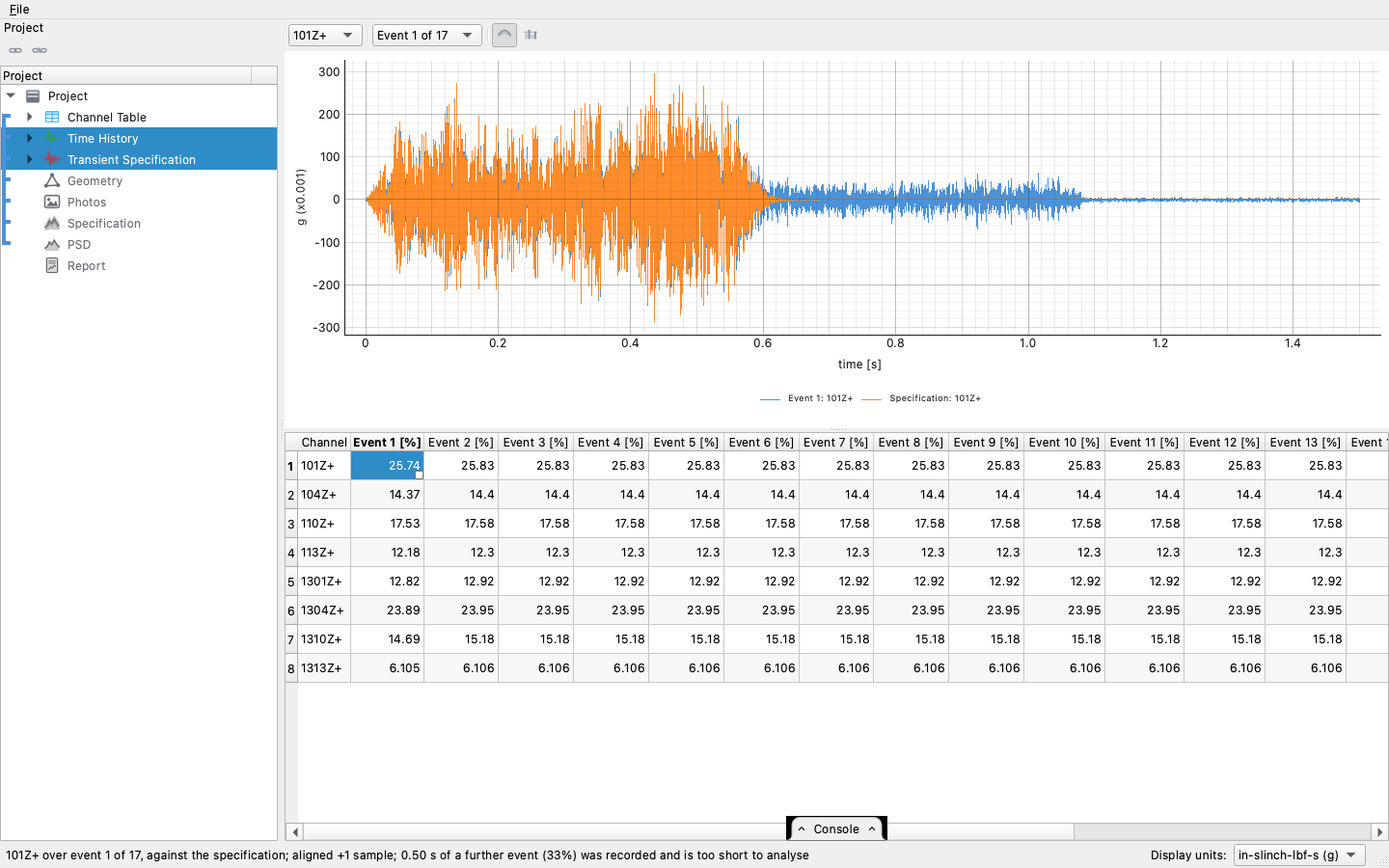
Select the measured history against the specification and the replication views appear on the plot bar. Waveforms draws each playing on the target, one control channel at a time; the grid below is every channel through every playing, and picking cells points the plot at them. Alignment is handled — a playing is compared where it landed, not where the clock says it should have.
Picking works record by record too: expand both objects in the tree and select one channel's records on each side, and the comparison draws the DOFs the two picks share. Picks that share no channel — the measured 104Z+ against the specification's 101Z+ — draw nothing, with the reason in the plot, because overlaying two different channels would be a comparison that looks like one and is not.
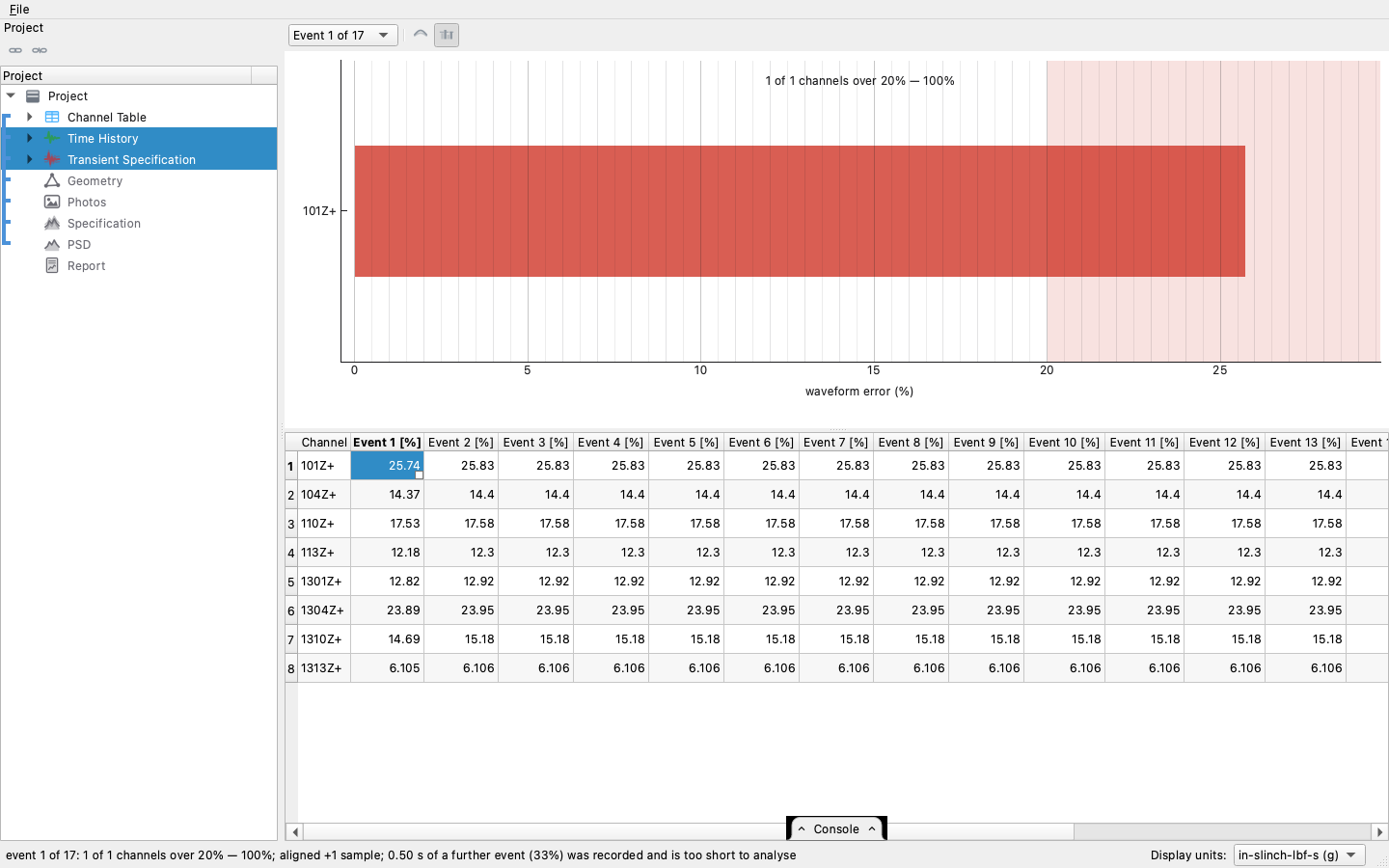
The waveform error view reads the same grid as bars: the difference between the two waveforms against the size of the target, per channel per playing. Amplitude, phase and shape all move it, and it is what the controller was minimising.
4. Then compare levels
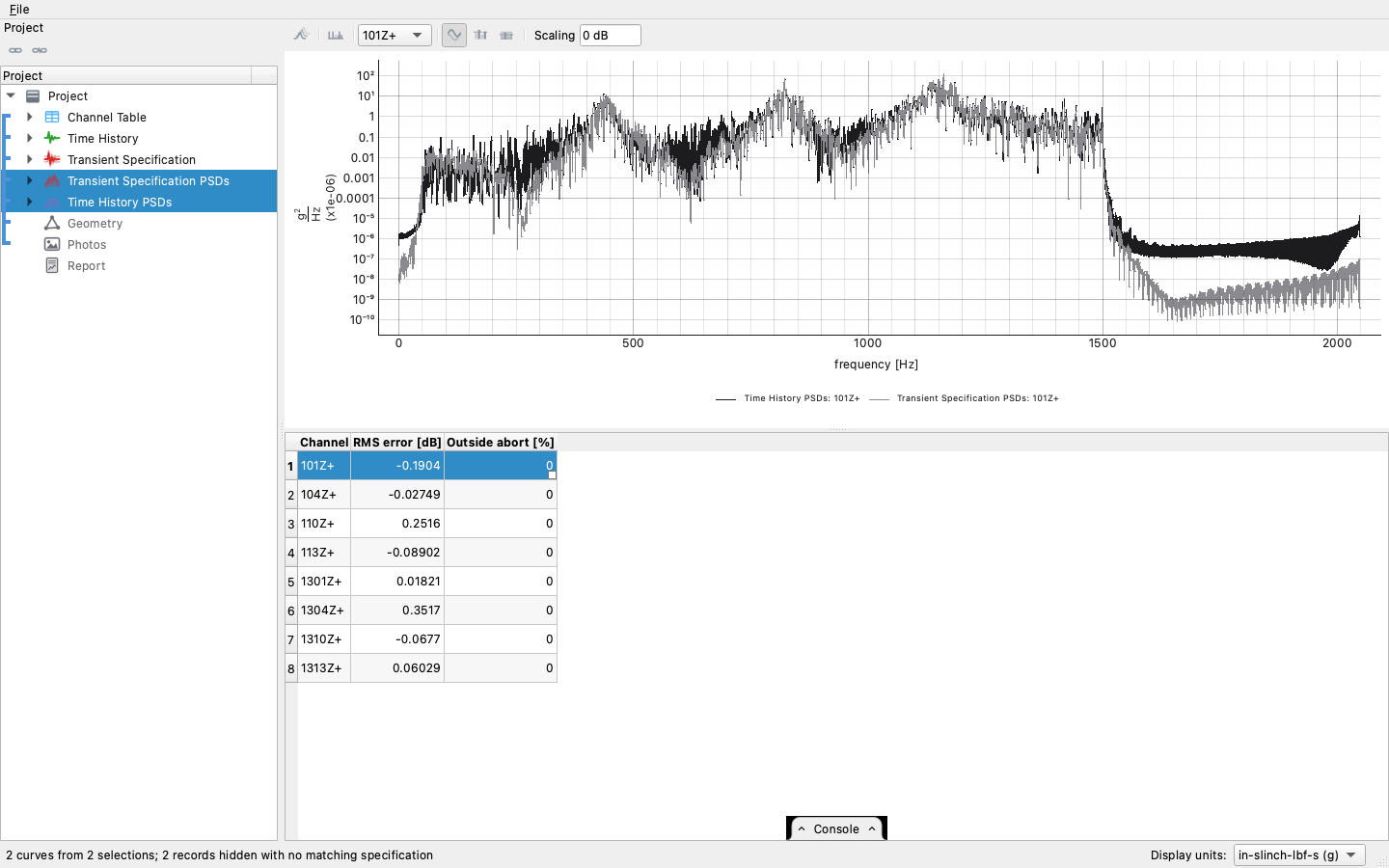
Compute PSDs from both sides (each history's averaging view). The target's own PSD arrives as a specification — a spectrum of a specification is still a specification — so selecting the pair gives the run a second reading: energy against frequency, the scale with shape and phase divided out. No SRS here: a shock response spectrum is how a shock test is judged, and that reading lives in the shock workflow.
5. Geometry, photos, report
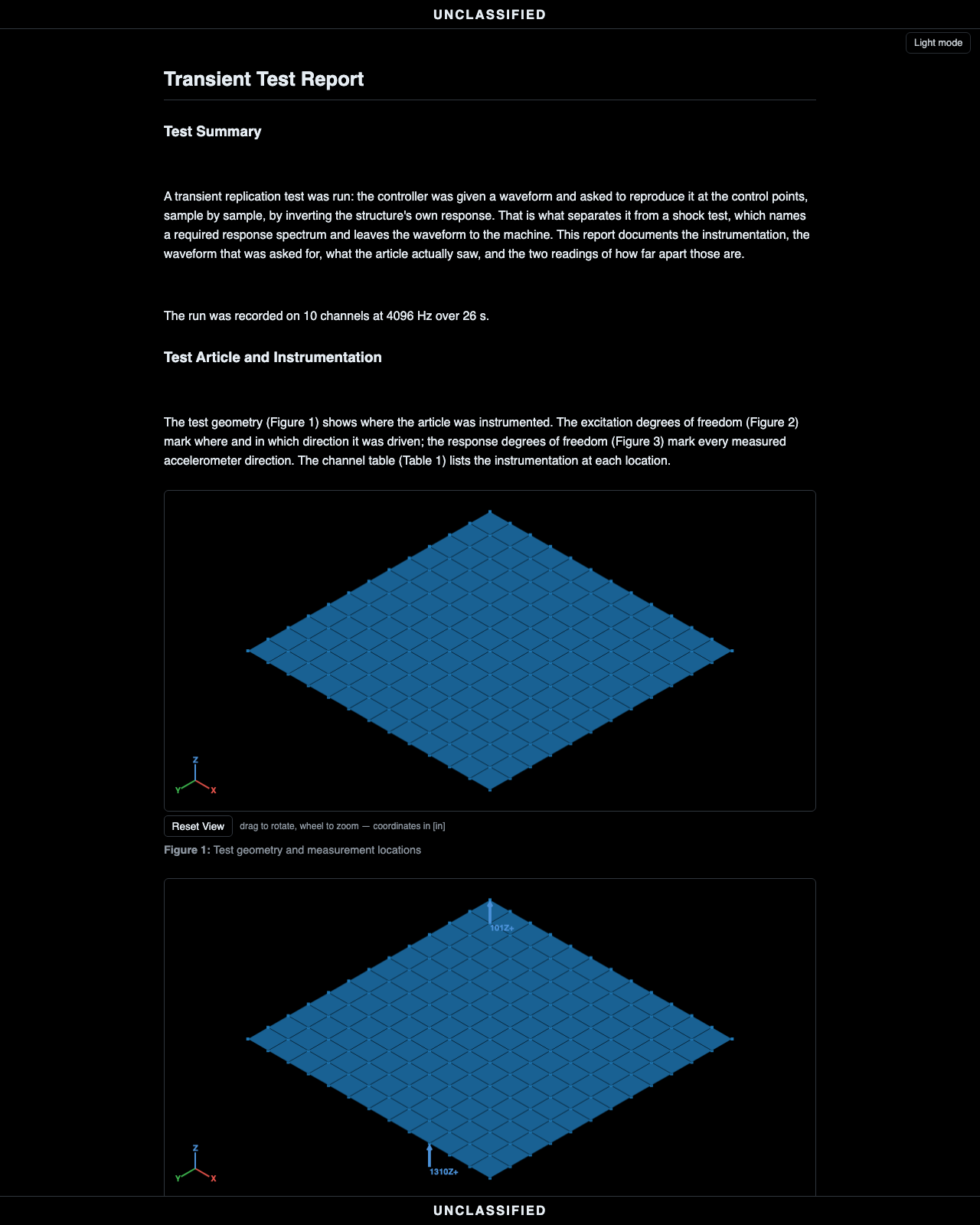
Drag the article's geometry in, declare its units, add the setup photographs, link the group. The transient report is deliberately shorter than the random one: there is no settled numerical compliance measure for two transients, so the waveforms lead — the target, the measured response, the overlay, the error bars — the level follows, and the judgement is written in the conclusions.
The same run, headless
And the script never has to be reconstructed by hand: the console tab along the bottom of the window writes it live as you click — every act of the session as the line that replays it. Expand it, copy the stretch you want, and it runs as-is.
import visualdynamics
from visualdynamics.plot import plot_replication

project = visualdynamics.Project('Plate Transient Replication')

# 1. import — the target arrives as the Transient Specification
project.import_file('transient.nc4')
assert project.project_type == 'Transient'

history = project.time_history
spec = project.transient_specification

# 2-3. the waveform views, headless
plot_replication(history, spec, 'overlay', path='overlay.png', show=False)
plot_replication(history, spec, 'waveform', path='error.png', show=False)

# 4. the spectral pair: the target's PSD is a Specification
project.compute_psds(spec)
project.compute_psds(history)

# 5. geometry, photos, report
project.add('Geometry', visualdynamics.import_file('geometry.npz'))
project.geometry.define_units('m')
project.link(*project.names)
project.set_basis(*project.names)
project.generate_report('transient')
project.export_report(project.report, 'transient_report.html')
project.save('transient.vdyn')
Where judgement lives
- Whether the reproduction is close enough. There is no band to fall outside: the overlay is the evidence, and the waveform and RMS error bars quantify it without deciding it. The conclusions section is where the decision is written. The demo run's 6-26% errors are themselves informative: two shakers cannot exactly reproduce an eight-channel motion, and the numbers say how close they came.
- Which channels are controls. The controller's file says which channels it controlled to; monitors ride along. The report compares where a target exists and leaves the rest drawn but unjudged.