Judging a cross-spectral matrix against its specification
A multi-input random test is controlled to a matrix. Its diagonal is each control channel's autospectrum, the level that channel is held at; its cross terms say how each pair of channels moves together. A run can hold every level inside its band and still not be the test that was asked for: two channels that were to move together may have moved independently, or in opposition. This page describes how Visual Dynamics judges the whole matrix, in the app and from a script.
What is compared
The specification is a Specification with cross terms, such as one
written on the specification sheet (SpecificationDraft), where each
pair is entered as a coherence and a phase, or one imported from a
controller. The measurement is the run's cross-spectral matrix,
compute_cpsds on the time history. The control channels are the
specification's autospectra, in its order, paired with the
measurement's records by DOF and quantity, as every comparison pairs
them. A set of autospectra with no cross terms is compared channel by
channel (How a comparison is judged), not as a matrix.
The rule
- The levels. Each autospectrum is compared with its specification exactly as a single channel is: power against power cell by cell, the share of the band outside abort and the RMS error in dB. A level is out when more than 10 percent of its band is outside abort or its RMS is more than 3 dB off, and the diagonal passes or fails by the rule a set of channels does. A measured autospectrum with a line that is not a number inside the band is refused, naming the count, since the line would otherwise be counted as no power.
- The coherence. For each pair the specification writes a cross term for, the ordinary coherence, |Spq|² / (Spp Sqq), is read from the specification and from the measurement at every measured line. A line is out when the two differ by more than the coherence tolerance, an absolute difference.
- The phase. The phase of the same cross term, arg Spq, is read the same way, and a line is out when the two differ by more than the phase tolerance, taken the short way round the circle (a phase 350 degrees off is 10 degrees off). The phase is judged only where the specified coherence is at least the floor: two channels asked to be nearly independent have no phase to hold.
- The share. A cross term is out when either reading is out on more than 10 percent of the lines it judged, the share a level is allowed outside abort.
- The verdict. The matrix passes when the diagonal passes and no cross term is out. The verdict line also counts the cross terms and levels that were asked for and not judged (not measured, refused, or every line set aside), so a pass over the rest is not read as a pass over them.
A cross term is stored as conj(X_p)·X_q, the way compute_cpsds makes
it, so its phase is the angle by which the second channel leads the
first, and the term of q against p is its conjugate. A term held only
the other way round is read as that conjugate. A matrix that holds a
pair both ways round with the two not conjugates of each other, or two
records for one entry, is refused: which one is meant is not in the
data.
The specification is read the way it is drawn, by the one reader the drive prediction and the specification sheet use too. Between breakpoints each term's magnitude is read log-log and its phase linearly, so a pair entered as one coherence and one phase keeps exactly that coherence and phase at every line between the breakpoints. On a specification of lines or bands, a line takes the value of the bin it falls in. A coherence of zero, two channels stated to be independent, is a value and is judged. A pair the specification writes no cross term for is not judged and is said to be not specified: an unstated pair is not a statement that the channels are independent.
The defaults, a coherence tolerance of 0.1 either way, a phase tolerance of 10 degrees either way and a floor of 0.5, are examples of what test documents ask for. The test plan states its own.
Why a share of the lines and not the worst line
A coherence and a phase read from averaged spectra scatter about their
true values. The normalized random error of a coherence estimate is
√2 (1 − γ²) / (|γ| √n) at n averages, and the standard deviation of
a phase estimate is √(1 − γ²) / (|γ| √(2n)) radians. At a coherence of
0.5 and a hundred averages the coherence scatters by about 0.05, so a
run that is exactly its specification puts a few percent of its lines
past a tolerance of 0.1 by chance, and below the floor the phase
scatters by tens of degrees. A cross term judged by its worst line
would fail a correct run. Judged by the share of its lines, it fails
when the departure is real. Fewer averages widen the scatter, and a
run judged against a tight tolerance needs enough of them.
So a line is judged only where its tolerance is at least twice the
estimate's scatter at the averages the measurement holds (half its
statistical degrees of freedom, which compute_cpsds stores with the
matrix). At a coherence of 0.5 and about sixty averages the coherence
scatters by 0.065: a tolerance of 0.1 is inside twice that, and runs
that were exactly their specification failed every time. Those lines
are set aside and the cell says so, with the count of averages, rather
than giving a verdict chance would decide. A measurement that does not
say how many averages it holds is judged on every line, with a note.
Each measured line also carries two numbers for the whole matrix: the RMS over the control channels of their level errors in dB, and how many cross terms are out at that line. Watched at each step of a step-up, they show where the matrix is diverging before the verdict changes.
In the app
Select the specification and the run's CPSD together, and choose Matrix on the plot's bar. The plot becomes a grid with one row and one column per control channel: each channel's autospectrum over its specification and abort limits on the diagonal, each pair's coherence above it and the same pair's phase below it, the measurement solid, the specification dashed and the tolerances dotted. Every cell's title names its reading and its verdict, with OUT in capitals for a cell that is out, and the frame says it again: heavy and solid round a cell that is out, thin round one that is in, dotted round one that was not judged or not specified. The lines judged out are marked with a cross on the measured curve. Under the grid, two strips give the per-line summary.
The Matrix panel beside the plot holds the settings:
- Coherence [±]: the coherence tolerance.
- Phase [±°]: the phase tolerance, in degrees.
- Phase from γ²: the specified coherence a phase is judged from.
Under them the panel gives the verdict and every cell in words, the levels first and then each pair's coherence and phase. Every edit redraws the grid. The measured levels are compared at the comparison's scale, the same one the channel comparison and the report use; the coherence and phase do not change with it. Unchecking Matrix goes back to the channels.
From a script
from visualdynamics.core.matrix_comparison import compare_matrix
from visualdynamics.plot import plot_matrix_comparison

cpsd = history.compute_cpsds()
result = compare_matrix(specification, cpsd)
print(result.describe())
for row in result.table():
    print(row['label'], row['reading'], row['words'])
plot_matrix_comparison(specification, cpsd, path='matrix.png', show=False)
For a three-channel run whose third channel's phase to the first walks 40 degrees off its specification above 800 Hz, with every level and every coherence held, this prints:
fails: levels pass on 3 channels; 2 of 3 cross terms out (coherence 0, phase 2)
101X+ level in: 0.0 % of lines outside abort, +0.0 dB rms
102X+ level in: 0.0 % of lines outside abort, +0.0 dB rms
103X+ level in: 0.0 % of lines outside abort, +0.0 dB rms
101X+/102X+ coherence coherence in: 0 of 1981 lines past ±0.10
101X+/102X+ phase phase in: 0 of 1981 lines past ±10°
101X+/103X+ coherence coherence in: 5 of 1981 lines past ±0.10
101X+/103X+ phase phase out: 45.0 % of 1981 lines past ±10°
102X+/103X+ coherence coherence in: 23 of 1981 lines past ±0.10
102X+/103X+ phase phase out: 45.1 % of 1981 lines past ±10°
The phase of the third channel to the first has walked out, and since the second is coherent with the first, its phase to the third has walked out with it. The coherences each have a few lines past 0.1, the scatter of the estimate, and are inside.
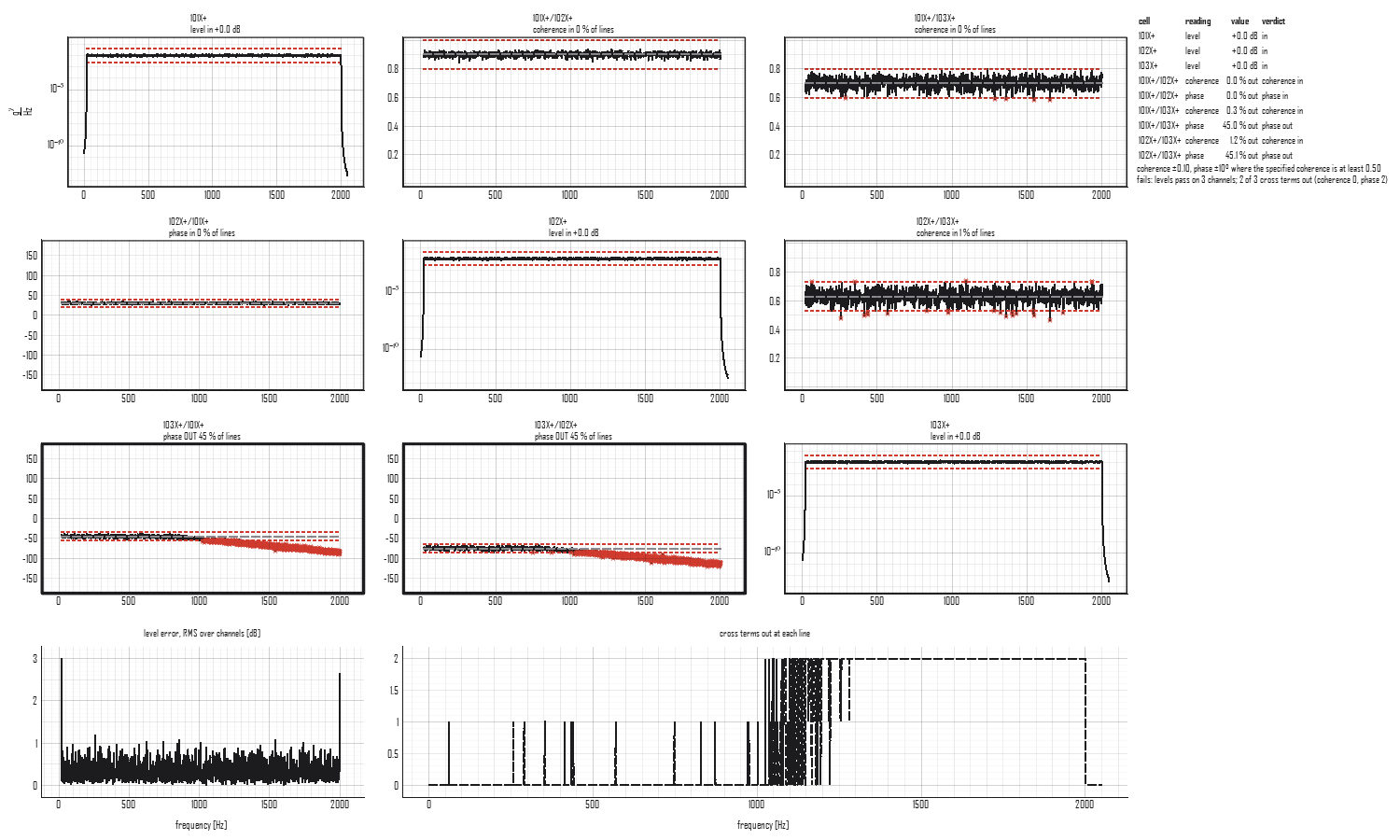
compare_matrix takes coherence_tolerance=, phase_tolerance=,
coherence_floor= and scale_db=, and spec_records= and
measured_records= to restrict either side. The result's levels
hold each channel's comparison, its pairs each cross term's
specified and measured coherence and phase at every line with the
lines out, and cell(row, column) what one cell of the grid shows.
cross_term_lines is the per-line judgment of one cross term on plain
arrays.
A cross term is never read as a level. compare refuses one, and
compare_all compares the autospectra only: a cross term's real part
is not the power of either channel, and it moves with the phase.