The run log file
A run log is the record kept on the floor while a test runs: when each level was reached, who called a stop and what was heard, when the clocks were checked, who came and went, what was noted. It is kept by a log keeper who is not at the controller, it rolls from one test to the next on the same article, and it opens with or without a Visual Dynamics project, so a lab that analyzes its data in other tools can keep one too.
Each thing written down is one entry, and an entry is never edited. A mistake is put right by a correction: a later entry that names the one it corrects and carries the new values. Whoever reads the log sees the corrected view, and the record keeps both.
From a script
from visualdynamics.core.run_log import RunLog

with RunLog.create('article-7.vdlog', title='Article 7',
                   mirror='//share/logs/article-7.vdlog') as log:
    log.append('clock_check', author='AB', fields={'offset_s': 1.25})
    log.append('test_opened', author='AB', test=1,
               fields={'title': 'Random, Z'})
    log.append('level_row', author='AB', test=1, axis='Z', run=1,
               fields={'level_db': -12.0, 'current': 63.0, 'go': True})
    stop = log.append('abort', author='AB', test=1, axis='Z', run=2,
                      fields={'stop': 'amplifier trip'})
    log.correct(stop, author='AB', fields={'channel': '4'},
                text='channel read off the panel')
RunLog.open opens an existing log to add to it, and RunLog.read
opens any log read-only. log.view() is the corrected view;
log.entries is every entry as stored, corrections included.
The Run Log window
File > Run Log opens the log in a dock at the side of the main window. Like the project tree it can be dragged to another edge, and it can also be floated out to a window of its own on a second monitor; it opens next time where it was left. The log keeper is not the person at the controller, so the dock belongs on the keeper's own computer, or on a monitor that does not cover the control screens.
visualdynamics --run-log article-7.vdlog opens the main window with
the log filling it and the project tree, the 3-D view and the plots
hidden, for the keeper's computer or for a lab that analyzes its data in
other tools. On Windows the Start menu has a Visual Dynamics Run Log
shortcut that opens it this way. Nothing 3-D is built while the log is
alone, so the window starts quickly and runs on a computer without the
graphics the 3-D view needs. Whole Window on the dock's bar brings
the rest of the window back, and the first 3-D view after that checks
the graphics first, as every first 3-D view does. A log named on the
command line that does not exist yet is offered to the New Log form,
and written only when it is confirmed.
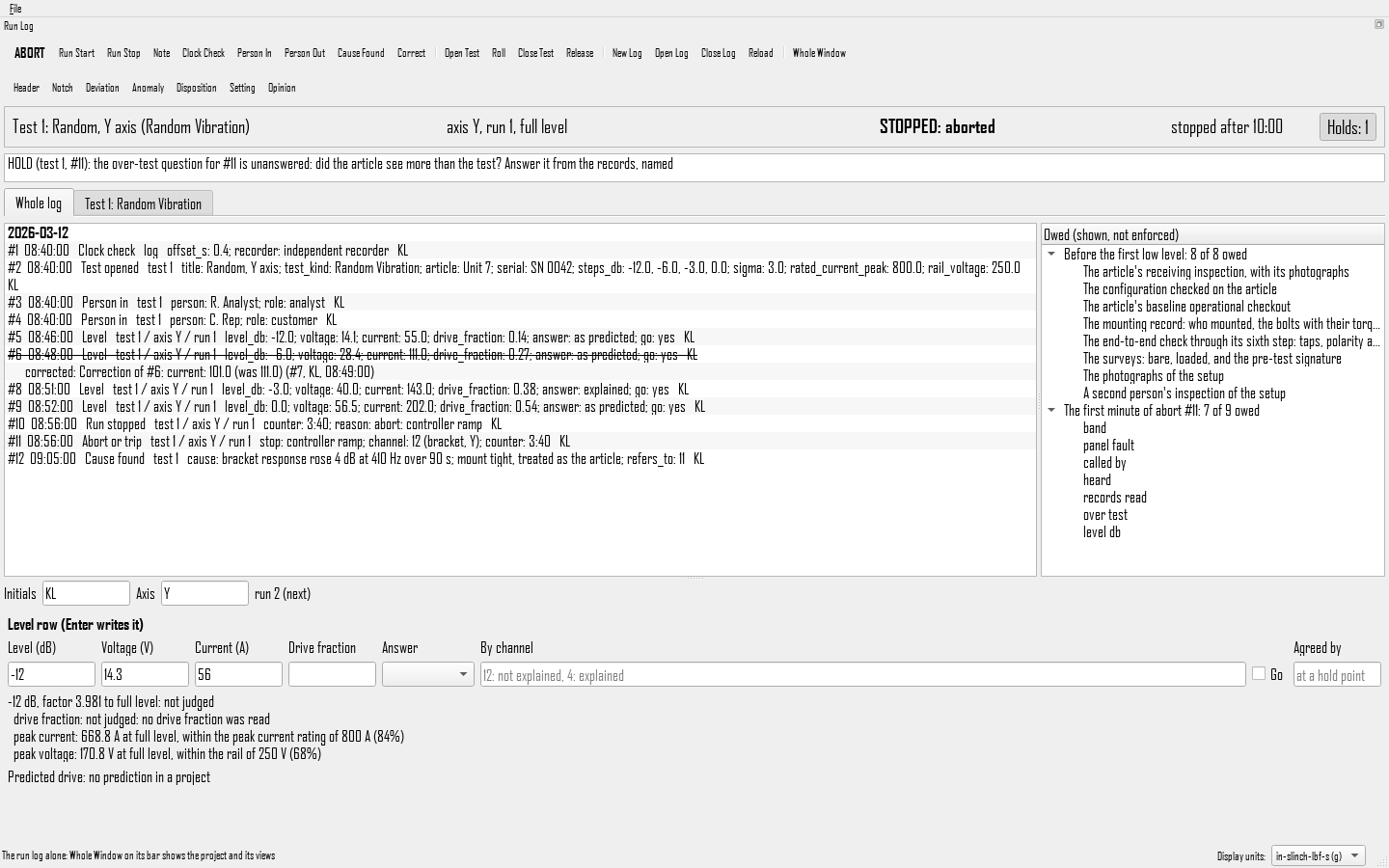
The window is drawn in large type, to be read from across the room.
- The status strip across the top reads the current test, its axis, run and level, whether the run is running or stopped and how it stopped, in words, the time since the run started, and the holds, counted. Holds lists them. A log open read-only says who holds it, and a mirror that could not be written says so here.
- The tests are a strip of tabs, the whole log first, so an earlier test is a click away. A keeper looking at the current test follows it to the next one when the log rolls.
- The day lists every entry in the order written under its date. A corrected entry is shown as it was written, struck through, with the correction beneath it saying what changed and what the value was; a late entry is marked with when it was entered.
- The owed lists beside the day show every line still owed. They are shown, never enforced.
Every entry needs its author's initials, typed once into Initials; Axis holds the axis the next run is on. Each act takes its event time when it starts, not when it is written: a form when it opens, the level row at its first keystroke. A form's event time can be changed for an event entered late.
The level row is one entry for each step of the step-up. Its level
is offered from the test header's step schedule, the next step after
the last one written in the run, and the voltage, current and drive
fraction follow in tab order, then the analyst's answer, the answers by
channel (12: not explained, 4: as predicted), the go, and who agreed a
go at a hold point. Enter in any box writes the row, and the next
step is offered. As the row is typed, the projection to full level is
shown beneath it, each check that cannot be made saying why:
-12 dB, factor 3.981 to full level: not judged
  drive fraction: not judged: no drive fraction was read
  peak current: 752.4 A at full level, within the peak current rating of 800 A (94%)
  peak voltage: not judged: no voltage was read
The abort is one key, Ctrl+Shift+A, which works while typing anywhere in the dock. The event time is taken at the key, and the form it opens needs only the kind of stop; Enter writes the run stop and the abort together, both at that time. The channel, the line or band, the panel fault, the counter, who called the stop, what was heard, the records read and the over-test answer can be written then or later, by correction; what is left blank is listed as owed.
The rest are small forms on the dock's bar, each written with Enter and put away with Esc:
| Act | Key | Writes |
|---|---|---|
| Abort | Ctrl+Shift+A | a run stop and an abort |
| Run Start | Ctrl+Shift+R | the run's start, with its level and counter |
| Run Stop | Ctrl+Shift+S | a stop that is not an abort |
| Note | Ctrl+Shift+N | a note |
| Clock Check | Ctrl+Shift+K | the recorders' clock less this computer's |
| Person In, Person Out | Ctrl+Shift+I, Ctrl+Shift+O | who came or went, and their role |
| Cause Found | Ctrl+Shift+C | the cause of an abort, the latest unanswered offered |
| Correct | a correction of the entry picked in the day | |
| Open Test, Roll | a test opened, or the roll to the next with the header carried | |
| Close Test, Release | a test closed to runs, or released | |
| New Log, Open Log, Close Log | the file: closing releases it for another writer | |
| Level Row | Ctrl+Shift+L | back to the level row |
A second bar holds the forms for the header and the readings:
| Act | Key | Writes |
|---|---|---|
| Header | Ctrl+Shift+H | changes to the current test's header, and the carried fields confirmed |
| Sweep | Ctrl+Shift+W | a sine sweep: direction, n of N, rate, span, level and current |
| Shot | Ctrl+Shift+P | a shock shot with its four checks and its pulses |
| Result | Ctrl+Shift+F | a survey or functional run's result and who ran it |
| Notch | Ctrl+Shift+T | a notch: axis, channel, band and depth |
| Deviation | Ctrl+Shift+D | a deviation, the latest unanswered hold offered |
| Anomaly, Disposition | Ctrl+Shift+M, Ctrl+Shift+X | an anomaly opened, with its owner, and dispositioned |
| Setting | Ctrl+Shift+G | a setting changed, and what it governs |
| Opinion | Ctrl+Shift+E | an opinion given to the customer, and to whom |
Every key has a modifier, so none is taken from a box being typed into. Sweep, Shot and Result are offered only for a test whose runs hold them: Sweep for a sine test, Shot for a shock or transient test, Result for a modal, system identification or functional test, all three for a test of kind Other.
The header. Open Test, Roll and Header show every field of the test
header, in groups: what the test is (kind, title, class and purpose, the
article, its serial and configuration), the governing documents and
their revisions, the step schedule and hold points, the planned notches
(Z: 180-220 Hz, 6 dB; 400-450 Hz, the axis and depth where the plan
gives them), the limits and tolerances, the duration and its tolerance,
the amplifier (sigma, the peak and continuous current ratings, the rail
and the drive window), the projected headroom from the handover, and
the pulse budget. Files named on the opening or the roll (the plan, the
procedure, the profile) are attached by SHA-256, read and hashed on the
log's own thread as the entry is written. Roll offers the current
test's header as it stands; every field left as offered is carried, and
the next test's Header form marks it (carried) until it is changed
or confirmed with Confirm.
The readings. Each form computes what the log will judge from what is typed, under its boxes, before anything is written:
- Sweep reads the amplifier's rms current at the sweep's level
against the header's continuous current rating, which is what a sine
test budgets, projected to full level as the level row is:
Sweep 1 of 3. Continuous rating: 398.1 A at full level, within the continuous current rating of 400 A (100%)
The next sweep of the run is offered as n, with N, the rate, the span and the level as the last sweep had them. - Shot lists the four checks made after every shot (the pulse or spectrum against its tolerance in both polarities, the displacement and velocity against the stroke, the amplifier's current and voltage peaks, the controller's prediction for the next level), which are answered and which owed, and counts the pulses against the header's budget, so far and with this shot. Every shot counts, a missed one too; a check left blank is listed as owed. - Notch says whether the notch is in the header's planned list on its axis, band and depth, as the log will judge it; one that is not holds the test until a deviation names it.
Predictions beside the readings. When the window has drawn a notch prediction or a drive prediction for the project open in it, the dock keeps the last of each and shows it beside what is read: a notch entry shows the notch predicted at its band, in the prediction's own words, beside the band and depth observed, and the level row shows the predicted drive beside the drive fraction read, projected to full level. Nothing is predicted in the dock itself. With no prediction drawn (always so for the log alone with no project) each place reads no prediction in a project.
Findings. A deviation carries the fact at the console; its cause, effect and approval are written when they are known, then or later by correction. The names typed into Agreed at the console by are recorded as that: the log does not track signatures or approvals and holds no deviation open waiting for one. A deviation answers a hold only when it names the entry that raised it, and the form offers the latest unplanned notch or change to the test still unanswered. Anomalies are opened with their owner and closed by a disposition naming their number.
A log already open for writing in another Visual Dynamics, or elsewhere, opens read-only, and the strip names who holds it; Reload reads what its writer has added since. Each entry is written, synced and mirrored on a thread of its own, and the model is read again there after each one, so the keeper never waits for the disk, a mirror on a slow share or a file being hashed before typing the next entry.
The file
A .vdlog is JSON Lines: UTF-8 text, one JSON object per line, readable
in any text editor and by any language with a JSON reader. The first
line is the header, with the format's stamp, its version, the log's id
and when and where it was created:
{"format": "visualdynamics-run-log", "version": 1, "log_id": "c450fa86…", "created": "2026-10-30T08:00:00.000-06:00", "title": "Article 7", "login": "tester", "computer": "bench"}
Each line after it is one entry:
{"id": 5, "kind": "abort", "event_time": "2026-10-30T08:02:00.000-06:00", "entered_at": "2026-10-30T08:02:00.000-06:00", "author": "AB", "login": "tester", "computer": "bench", "test": 1, "axis": "Z", "run": 2, "fields": {"stop": "amplifier trip"}, "text": "", "files": [], "prev": "9b1f…", "hash": "e04c…"}
Every entry has its id (numbered from 1 across the whole log), its kind, its event time (when the thing happened) and its entered-at time (when it was written down), each with its date and its UTC offset, the author's typed initials, the computer's login and machine name, the test, axis and run it belongs to (any of them absent), the fields of its kind, free text, the files it names by SHA-256 (each with its name and size, and when known its format, what it holds and where it was), and its two links in its test's chain.
Each entry is written, flushed and synced to the disk before the call
that wrote it returns, so a crash, a pulled plug or a killed program
loses at most the entry being written. A file cut off in the middle
of its last line is read up to that line, and the torn line is named
in log.problems; opened again for writing, the torn line is ended,
not removed, and the next entry starts on a line of its own. Any other
line that cannot be read is skipped and named the same way, and the
rest of the file is read.
Versions
The header's version says which format the file is in. Each version
has its own reader, and a later Visual Dynamics keeps the reader of
every earlier version, so it reads every earlier file; a frozen file
of each version under testdata/vdlog_corpus/ is opened by the tests
on every run. A file from a newer version is refused with a message to
update. Entries are only ever added to a file in the version this
build writes; an older file opens read-only.
The format may change while Visual Dynamics is an alpha. From the first release that is not an alpha, an older file always opens.
Entries
Each kind of entry asks for as little as it can, because the first minute after a stop is the worst moment to be refused. An abort needs only its time, the kind of stop and its author; the channel, the panel fault, the counter, who called it and what was heard can all come later, by correction. A field left blank is left out.
| Kind | Needs | May carry |
|---|---|---|
test_opened |
the test | the header's fields (below), carried |
test_closed |
the test | reason |
header_change |
field (a header field), value | was |
clock_check |
offset_s | recorder, method |
person_in, person_out |
person | role |
brief |
attendees, topics | |
checklist_reading |
item | reading, taken_by |
setup_step, post_test_step |
step | result |
run_start |
level_db, counter | |
level_row |
level_db, voltage, current, drive_fraction, answer, channel_answers, go, agreed_by | |
sweep |
direction, n, of, rate, span, level_db, current | |
shot |
polarity, n, of, level_db, pulses, in_tolerance, within_stroke, peak_current, peak_voltage, prediction | |
run_stop |
counter, reason, scheduled, result, by | |
abort |
stop | channel, band, panel_fault, counter, called_by, heard, records_read, over_test, level_db |
cause_found |
cause | refers_to |
path_decided |
path | refers_to |
restart |
resume, counter_at_stop, counter_at_restart, cause, decided_by, refers_to | |
notch |
channel, band, depth_db, planned | |
deviation |
number, fact, cause, effect, approval, agreed_by, refers_to | |
anomaly_opened |
number, fact, owner, refers_to | |
anomaly_dispositioned |
number | disposition, by |
adjustment |
what | |
photo |
subject | |
setting_change |
setting | value, was, governs |
opinion_given |
to, opinion | |
observation, note |
The kind of stop is one of controller ramp, amplifier trip, power loss
and stop word: a hard shutdown may have over-tested the article, which
is why it is asked first. A level is a signed number of decibels
relative to full level (−12 for twelve below). refers_to names an
earlier entry by its id. A name typed into a deviation (agreed_by)
records who agreed at the console; the log does not track signatures or
approvals.
A few fields take one of a fixed set of words, and anything else is
refused: an answer (and each channel's answer in channel_answers) is
as predicted, explained or not explained; what a setting governs is
limit, tolerance, abort band or other; a sweep's direction is up or
down. A sweep's span is a band (5-2000 Hz), refused when it cannot
be read as one; its rate is written as the controller gives it, in
octaves per minute or hertz per second. A restart's resume is yes when the test continues with the time
already run counted, and no when it starts again.
Deviations and anomalies are numbered across the whole log, D-1, D-2, A-1, in the same form as the report's findings register, so a number names one finding however many tests the log spans.
Tests, axes and runs
visualdynamics.core.run_log_model reads a log as tests, axes and
runs. RunLogModel(log) is built from the log's corrected view when it
is made; nothing it shows is stored in the file, so a hold, an owed
line or a credited duration is always what the entries say now. Make a
new one after the log changes.
from visualdynamics.core import run_log_model as model

with RunLog.open('article-7.vdlog') as log:
    model.open_test(log, author='AB', test_kind='Random Vibration', header={
        'title': 'Random, Z', 'steps_db': [-12, -6, -3, 0],
        'hold_points_db': [-3], 'sigma': 3.0, 'rated_current_peak': 800.0,
        'rail_voltage': 250.0, 'duration_s': 600.0,
        'duration_minus_pct': 0.0, 'duration_plus_pct': 10.0,
        'notches_planned': [{'axis': 'Z', 'band': '180-220 Hz',
                             'depth_db': -6}]})
    model.append(log, 'level_row', author='AB', test=1, axis='Z', run=1,
                 fields={'level_db': -12.0, 'voltage': 20.0, 'current': 63.0,
                         'drive_fraction': 0.12, 'answer': 'as predicted',
                         'go': True})
    state = model.RunLogModel(log)
    state.holds(), state.owed(), state.credited(1)
A test has a kind, one of the project types (Modal Test, Random Vibration, Transient, Shock, Sine Sweep, Random and Sine, System ID) or Functional or Other, so a report's template follows from one word. Its header is what the test is (title, class, purpose), the article and serial, its configuration, the governing document and its revision, the plan and procedure revisions, the profile's source, and the plan's numbers the log checks against:
| Field | Holds |
|---|---|
steps_db, hold_points_db |
the step schedule and the hold-point levels, in dB relative to full level |
notches_planned |
each planned notch: its band, and its axis and depth where the plan gives them |
limits, tolerance, abort_bands |
the limits, tolerances and abort bands, as text |
duration_s, duration_minus_pct, duration_plus_pct |
the duration per axis and its tolerance, minus and plus |
sigma |
the drive's peak-to-rms ratio |
rated_current_peak, rated_current_rms, rail_voltage |
the amplifier's peak and continuous current ratings and its rail |
drive_window |
the drive fraction's window at full level, low and high |
projected_current, projected_voltage |
the projected headroom from the plan's handover |
pulse_budget |
the pulses a shock test may give |
The files the header attaches (the plan, the procedure, the profile)
go on the test's opening entry by SHA-256. model.change_header
changes one field and records the value it had.
A test is open until it is closed (model.close_test) or the next
test opens. Then it is closed to runs, and still takes findings,
post-test steps and dispositions until its release (model.release,
the release checklist's release line), after which it is released
and takes no new runs, findings or header changes. An anomaly opened
before the release can still be dispositioned after it, since the
board that disposes of it meets later. model.append refuses what a
test's state does not take, with a message naming the test and its
state; an entry written past its state by other means is named in the
test's problems.
The roll (model.roll) closes the current test to runs and opens
the next with the header carried from the last. Every field not given
anew is carried, and the header marks it carried
(test.header.carried) until it is confirmed (model.confirm, which
records it unchanged) or changed:
model.roll(log, author='AB', test_kind='Shock',
           header={'title': 'Release shock', 'pulse_budget': 12})
model.confirm(log, 2, ['article', 'configuration'], author='AB')
Axes are named by the entries of a test, in the order first named.
Runs are numbered within a test, each on one axis, and what a run
holds follows the test's kind: a random run's level rows, ending at full
level with the counter at its stop; a sine run's sweeps, each with its
direction and its number of how many; a shock run's shots, each with
its four checks (the pulse against its tolerance in both polarities,
the displacement and velocity against the stroke, the amplifier's
current and voltage peaks, the controller's prediction for the next
level); a survey or functional run's result and who ran it, on its
stop. Every shot counts against the header's pulse budget
(state.pulses(test)), a missed one too.
Holds
A hold is something the log asks to be answered before the test goes on. Holds are worked out from the entries, never stored, and shown until answered; the log never stops the controller.
| Hold | Answered by |
|---|---|
| an abort with no cause | a cause found naming it, or the next cause found in the test |
| an abort whose over-test question is unanswered | the abort's over_test, written or added by correction |
| a restart with no cause | its cause |
| a "not explained" answer, for the run or a channel | a later level row on the same axis whose answers are all explained or as predicted |
| a notch not in the planned list | a deviation naming it (refers_to) |
| a limit, tolerance or abort-band change | a deviation naming it |
| a go at a hold-point level | the customer's agreement on the row (agreed_by) |
A notch is planned when it is on a planned notch's axis (a planned notch with no axis is on every axis), its band is inside the planned band, and it is no deeper than the planned depth where the plan gives one. It is judged against the header as it stood when the notch was written, so adding a notch to the plan afterwards does not plan it. A notch typed as planned is still judged against the list.
A change to a limit, tolerance, abort band, planned notch, hold point or duration tolerance in the header counts once the test is running (the header typed in before the first run is the plan written down); a header change to the value a field already has is a confirmation, not a change. A setting change counts when it governs a limit, a tolerance or an abort band, or, when it does not say, when its setting's name says limit, tolerance or abort. A deviation answers such a hold only when it names the entry: which change a deviation covers is not guessed from where it was written.
Owed lists
An owed list is a checklist, each line done by an entry, with who did
it and when, or still owed. state.owed() gives every list with a
line still owed, and state.checklist(test, name) one list whole:
- Before the first low level (
'before low level'): the receiving inspection, the configuration checked on the article, the baseline operational checkout, the mounting record, the end-to-end check through its sixth step, the surveys, the photographs, and a second person's inspection of the setup. - The axis change (
'axis change', to each axis after the first): the finished axis closed, the hardware from its bolt lists, the controller, the channel table, the end-to-end check, the surveys, the photographs, and the second person's look. - The release checklist (
'release'), owed once the test is closed to runs: the recorders stopped after the amplifier, the signature compared, the data check, the post-test functional, the inspection, the fixture, exciter and instrumentation inspected, every anomaly opened, the post-test review, the release, the article removed, the machine log and the flash report. - An abort's first minute (
state.abort_fields()): the channel, band, panel fault, counter, who called it, what was heard, the records read, the over-test answer and the level. A partial abort is accepted; what it lacks is owed here, done by a correction. - A shot's four checks (
state.shot_checks()). - A day with no clock check (
state.clock_days()).
A checklist line is done by a setup step (a post-test step for the
release checklist) whose step names the line by its key or its words,
ignoring case and hyphens: 'end-to-end check', 'End to end check'.
An axis change's steps are written on the new axis; its first line may
name the axis it closes. A line done after the list was due (the first
drive on the axis) is marked so.
Views
Each view is for one test (test=1), the entries between tests
(test=None), or the whole log (the default):
state.runs(), with each run's outcome: completed, stopped (a scheduled stop), aborted, or running.state.interruptions(): the aborts, trips and scheduled stops, each with the cause, the path decided and the restart that answer it.state.credited(): the time credited on each axis from the counters, against the duration and its tolerance. A run's time counts once it reaches full level; a segment runs from its start (0 unless a counter is given) or a restart's counter to the counter at its stop. A resume continues the count, a restart that starts again discards what was credited before it, and a run stop and an abort written together for one stop are one stop. A counter is seconds, minutes:seconds or hours:minutes:seconds. A segment whose counter is missing leaves the total a lower bound, and the verdict not judged, with why.state.holds()andstate.owed().state.chronology(): the entries in the order of their events, each with its time on the recorders' clock.state.findings()andstate.open_anomalies(): deviations and anomalies by number, with the dispositions against each, and the open anomalies with their owners.state.files()andstate.late().
The projection to full level
A low-level reading is projected to full level to see whether the full
level will fit. The level L is in dB relative to full level, negative
below it, and every reading is multiplied by 10^(−L/20) exactly. From
the readings and the header, state.reading(entry) (or
model.project(...) with the numbers) judges three headroom numbers:
- the drive fraction at full level against its window (the header's
drive_window, or a third to two thirds of the range); - the peak current at full level, the rms current times the plan's sigma, against the amplifier's peak current rating (and, when the header gives a continuous rating, the rms current against it, which is what a sine test budgets);
- the peak voltage at full level, the rms voltage times sigma, against the rail.
A worked example at −12 dB, with a sigma of 3, a peak rating of 800 A and a rail of 250 V:
| Reading at −12 dB | × 10^(12/20) = 3.981 | At full level | Against |
|---|---|---|---|
| 63 A rms | 250.8 A rms | 752.4 A peak (× 3) | 800 A: within, 94 percent |
| 20 V rms | 79.6 V rms | 238.9 V peak (× 3) | 250 V: within, 96 percent |
| drive 0.12 | 0.478 | 0.478 | 1/3 to 2/3: within |
The factor is 3.981, not 4, so 63 A projects to 250.8 A rather than 252 A. At −6 dB the factor is 1.995 and at −3 dB 1.413.
A check that cannot be made reads not judged, with why: no reading, a reading of zero (the meter or the amplifier is not reading), or a rating or sigma the header does not give. The projection's verdict is within only when every check was judged within; a projection with any check not judged is not judged, never a pass. A level above full, a reading that is negative or not a finite number, a drive fraction above 1, or a sigma or rating of zero is refused with a message naming it.
state.reading(entry) also compares the row's volts per amp with the
previous level of the same run, and its readings with the last run of
the same setup (the same level on the same axis in an earlier run of
the test, or of a test of the same kind and configuration), and flags a
ratio that moved more than 10 percent: a plant whose ratio of voltage
to current changed between levels has changed. The header used is the
header as it stood when the row was written.
Corrections
log.correct(entry, ...) writes a correction carrying the new values:
any of the entry's fields (None strikes an optional one), and its event
time, free text, test, axis or run. The corrected view applies every
correction in the order written; log.current(id) is one entry
corrected, with the corrections it took in corrected_by, and
log.entry(id) is the entry as it was stored. A correction belongs to
the corrected entry's test. A required field cannot be struck, a
finding's number is never changed, and a correction is not itself
corrected: the original entry is corrected again.
Times and the recorders' clock
Every time is stored with its UTC offset, so the hour that repeats when daylight saving time ends is never ambiguous, and an interval across the change is the real interval. An entry entered more than ten minutes after its event is a late entry, marked as such wherever the log is shown.
The computer's clock and the recorders' clock drift apart. A
clock_check entry records the recorders' clock less this computer's,
in seconds (offset_s), with the recorder it was read against.
log.recorder_time(entry) gives an entry's time on the recorders'
clock, using the latest clock check at or before it (of one recorder,
when named); with no clock check before it, there is no recorders'
time, and it says so (None) rather than guess.
Integrity, and its limits
The entries of each test are chained by SHA-256. Each entry carries
the hash of the entry before it in the same test (prev), and its own
hash taken over its canonical form, which includes prev. The entries
between tests have a chain of their own, and every chain starts from
the log's header, so an edited header breaks them all. Because the
chain is per test, the entries of one test check on their own.
log.verify() checks every chain and names the first broken link by
test and entry: an entry whose hash does not match its contents, an
entry whose previous hash is not the entry before it (one was removed
or moved), and ids that skip or run backward.
What this detects is accidental damage, a file cut short, and casual
edits. It is not proof against deliberate alteration: anyone who
edits an entry can compute every hash after it again, and the edited
file then checks. A file cut off at the end of an entry also leaves a
valid chain. That is found only against a head recorded outside the
file: log.head(test) is the hash of the test's last entry, and
log.verify(heads={1: head}) reports when a recorded head is no
longer in the log. A report's data index can carry a test's head, so
the record outside the file anchors the record inside it. The login
and machine name every entry records beside the typed initials are
recorded, not authenticated.
One writer, and a second copy
A log open for writing holds a lock file beside it (article-7.vdlog.lock).
A second writer is refused, with a message naming the login and
machine that hold the log and since when; readers open it read-only
and are never refused. The lock is the operating system's, so a writer
that crashes leaves nothing holding the log.
Given a mirror, every entry is copied to a second path as well, the
lab's share or the data folder. A mirror that cannot be written (the
share is away) is reported in log.mirror_problem and never costs the
entry its place in the log itself; when the mirror can be written
again, the whole log is copied there, so it catches up.
Exports
The .vdlog is its own JSON export, and the one format the log is read
back from. Three views are written out from it
(visualdynamics.core.run_log_export), each for the whole log, one
test (test=1), or the entries between tests (test=None):
- Plain text (
to_text), for printing or attaching to a report: every entry in the order written, with its time and offset, author, login and machine, place and fields. A corrected entry is marked[CORRECTED by #4], and the correction says what it changed and what the value was (stop: power loss (was amplifier trip)); a late entry is marked with when it was entered, and an entry under a clock check with its time on the recorders' clock. The lines that could not be read, the chains' heads and what verifying found close it. - CSV (
to_csv): a row per entry as stored, corrections included, withcorrected_byandcorrectscolumns, alatecolumn, the time on the recorders' clock, and the fields as JSON. - The machine log (
machine_log_csv): the entries a lab's own machine log keeps (trips and aborts, setting changes, clock checks, people in and out, restarts, and the tests opened and closed, which say what was running), corrected, one row each: the local date, time and UTC offset, the recorders' time, the event in words, its details, the test and its title, the axis and run, the author, the entry's id, and whether a correction changed it.
from visualdynamics.core import run_log_export

run_log_export.export(log, 'article-7', 'text')          # article-7.txt
run_log_export.export(log, 'test-1', 'csv', test=1)      # test-1.csv
run_log_export.export(log, 'machine', 'machine')         # machine.csv
Controller files
A controller writes its records into an output folder as the test runs: a run's stream, its spectra, its settings. The log can watch that folder and propose each file that appears, for the run that was current when it appeared. Nothing is attached until the log keeper accepts the proposal; a proposal turned down leaves nothing in the log.
from visualdynamics.core import run_log_files as rf

watch = rf.ControllerWatch('D:/controller/output')
watch.start()                       # looks every 2 s on its own thread
...
for found in watch.take():          # proposals and problems so far
    if isinstance(found, rf.Proposal):
        rf.accept(log, found, author='AB')
watch.stop()
A file is hashed only once it has settled: its size and modification
time unchanged for five seconds (settle_s), seen on at least two looks,
since a file still being written would hash to a value its finished
bytes do not have. A file that changes while it is hashed waits to settle
again, and one removed before it settles is forgotten. Hashing reads at
most 32 MB a second (rate), because the file is on the controller's own
disk or share while the next run writes there. The files already in the
folder when the watch begins are earlier runs and are not proposed
(existing=True proposes them too). When a test closes,
watch.archive() (in the window, ask_archive()) hashes everything seen
and not yet hashed, settled or not.
The folders are listed every two seconds (poll_s) whether or not
anything says they changed, since a network share often sends no notice
of a change; a notice only makes the next look come sooner
(watch.poke()). The looking and the hashing run on a thread of the
watch's own that never holds up typing in the log. A folder named that
does not exist is refused with its path; one that goes away later (a
share that drops) is reported once and looked for again at each poll,
and a file that cannot be read is reported once and tried again.
Each proposal carries the file as a data index records it: its name,
path, size, SHA-256, format and what it holds, read through Visual
Dynamics' own importers. A Rattlesnake run gives its kind, channels,
sample rate and time stream from its dimensions alone, so a run of any
size is described without reading its data; another format an importer
reads is read whole up to 64 MB; and the run, axis and level the file's
name gives are added. A file nothing recognizes is kept with the format
unknown, by name, size and SHA-256; it is never refused.
| A file in the folder | Format | Holds |
|---|---|---|
shock_Z_run1.nc4 |
Rattlesnake controller output (.nc4) | Rattlesnake transient run; 7 channels, 101Z+ to 1Z+; 8192 Hz; time stream 2.8158 s; run 1, axis Z (from its name) |
notes.qqq |
unknown | not read: no importer recognizes its format; it is recorded by name, size and SHA-256 |
The stream against the counter
rf.check_stream(log, proposal) compares a Rattlesnake stream's length
with the time the run's entries counted: the last counter written at
the run's stop or abort less the counter at its start. A counter is
typed as 1:02:03, 12:30, 750 s or 12.5 min. The stream runs from
the controller's start to its stop, ramps included, so it is somewhat
longer than the counter; a difference of more than 30 s either way
(tolerance_s) is reported to the log keeper as a finding, shorter
("the stream may not hold the whole run") or longer ("more than the 30 s
allowed for its ramps"). Set the tolerance to what the ramps, and any
lower levels run inside the same run, take. Nothing is refused, and when
nothing can be compared (a spectral save with no time stream, a run with
no counter at its stop) the check says so and is not a pass.
Into the report's data index
puts each file the log names into the project's data index, with the
size and SHA-256 the log recorded, so nothing is hashed twice; the
index's check before a report is issued hashes each one again and says
whether it still matches. A file is looked for where it was hashed,
then by name in each search folder, then beside the log; one found
nowhere is listed as missing. The log's own file goes into the index as
a run log that holds each test's head hash, so the report's record of
data carries the anchor that log.verify(heads=...) checks the log
against. The data index is the project's one index of files: the log
writes into it rather than keeping one of its own.
In a project
A report holds references to the objects of its project, never data that can move under it, and a log keeps growing while the test runs. So a log is brought into a project as a run log extract: one test, frozen at a stated entry, the way photos are brought in.
import visualdynamics

project = visualdynamics.Project('Article 7')
name = project.attach_run_log('article-7.vdlog', test=1)   # to its last entry
extract = project[name]
extract.runs(), extract.interruptions(), extract.credited()
extract.findings(), extract.files(), extract.chronology()
extract.head                                    # the test's head hash
attach_run_log(path, test=1, upto=12) takes the test as it stood at
entry 12; with no upto it takes the log to its last entry, and with
no test the log's one test. The extract keeps the lines of the log
that test's views read, exactly as the file has them: the log's header,
the test's entries and the entries between tests up to that entry, and
the few entries written under another test that answer one of its own
(a cause, path, restart or deviation naming one of its entries, a
disposition of one of its anomalies, and the next test's opening when
that is what closed it to runs), each with its corrections. Its views
are what RunLogModel gave for the test at that entry, read from the
extract alone, so the extract reads the same wherever the project is
opened, with the log beside it or not. Comparing a reading with the
last run of the same setup in an earlier test needs that test, which
the extract does not hold.
attach_run_log refuses a file that is not a run log, a test the log
does not hold by the stated entry, an entry the log does not hold, an
entry before the cut that the log cannot read, and a chain of the test
(or the chain between tests) that does not verify, naming the chain,
the entry and the line. Each test's chain verifies on its own, so a
damaged entry of another test does not refuse this one, unless it is
one of the entries the extract keeps because it answers this test,
which is checked as well. With no upto
it refuses a last line that is still torn, since the entry being
written may be of the test; give the last whole entry as upto. A
fragment a crash left in the middle of the file, which the log itself
skips and its chain checks across, is named in the extract's
problems.
A report never changes because the log grew. extract.status()
compares the live file with the extract: its length first, and the
file is read only when the length has changed. It says current, or
newer with how many entries the log holds after the extract's last
one and how many of them are of the test (the badge reads "newer
entries in the log"), or changed when the file is another log or no
longer holds the entries the extract was taken from, or unreadable,
or missing when there is no file. None of these is an error, and the
extract stands as it was taken. project.refresh_run_log(name) takes
the log again to its newest entry, a step of its own that the journal
records; it is refused when the log has changed under the extract.
project.detach_run_log(name) takes the extract out. Each is undone
the way it was done: refreshing back to the upto the extract had, or
attaching again with the same test and entry, gives the same entries,
since a log is only ever added to.
The extract is saved in the project file whole. The log's path is saved relative to the project file when the log is in the project file's folder or one beneath it, so a folder moved or copied with its log still finds it, and absolute otherwise. A project holding an extract is stamped schema 3, and a Visual Dynamics that reads only schema 2 refuses the whole file with its message to update rather than open part of it; a project with no extract is stamped as before.
Drafts for the report's author sections
The chronology and the deviations are sections only the author writes. An extract offers text for them, never fills them:
draft = extract.draft_chronology()      # for the Chronology section
draft.text, draft.mark                  # Markdown; 'DRAFTED FROM THE RUN LOG, NOT YET ACCEPTED'
extract.draft_findings()                # for the deviations section
The chronology draft is the test's runs in order (axis, start, the
levels, sweeps or shots each held, the counter at the stop and the
outcome), its interruptions with the cause, path and restart the log
records, and the time credited on each axis. The findings draft is each
deviation and anomaly by number with its fact as typed at the console,
an anomaly's owner, and whether a disposition is logged; the cause, the
effect and the approval or disposition are the author's and are never
drafted. A draft is marked as drafted until the author accepts or edits
it, and the section stays owed until then. A log with nothing of a kind
offers nothing for it, not "none": an empty log cannot tell "nothing
happened" from "nobody wrote it down", so the draft's notes say what
the log does not hold, and setting a section to None stays the author's
step.